This Week's Citation Classic comes from the venerable
W. D. Hamilton. 1967. Extraordinary Sex Ratios. Science 156: 477-488. Here's a test. Read
pgs. 142-143 of R.A. Fisher's
Genetical Theory of Natural Selection. Then read the first paragraph of Hamilton's Extraordinary Sex Ratios. Both explain why the sexes usually come in equal numbers. Which is easier to understand? I suggest the latter.
Perhaps now you will understand why so many
evilutionary biologists hold Bill Hamilton in such high esteem. I still recall my initial reading of the paper during my first semester of graduate school. My advisor said to me one day, "mumble mumble dominance... mumble mumble sex ratios... mumble mumble foraging....mumble sex ratio... mumble have more males...." In his defense, he was probably speaking clearly. I was just so cowed that I had trouble concentrating. I left his office thinking, "I better read up on sex ratios". I look up "Sex Ratios" in
ISI Web of Knowledge. Wow... 8,549 results! OK, sort by times cited.
Hmmm... Extraordinary Sex Ratios 1,406 citations. OK, I'll start with that one.
My reaction on reading the first page: WHOA! So that's why the number of males and females are equal. Sex ratio is one of those things that seems obvious until you start to think about it. Darwin himself thought the problem of sex ratios was too difficult to tackle, and left it for future generations (
Descent of Man, p. 399). Fisher first figured it out as I mentioned above.
Much of Extraordinary Sex Ratios deals with exceptions from balanced sex ratios, usually cases where females outnumber males, and gives excellent examples of these. One example in particular totally blew my mind: the
Pyemotidae. Take
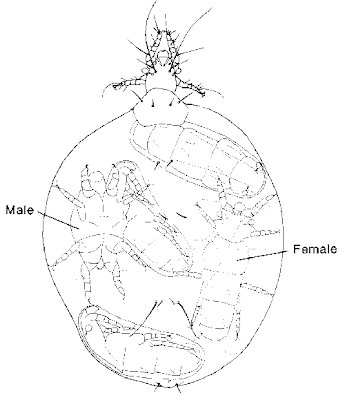
Acarophenax tribolii for example. These mites usually occur in broods biased 15-1 in favor of females, and they are quite naughty. The single male will mate with and fertilize all of his sisters. Hang on. Before you get too excited, all this happens in full view of the mother. Are you
slackjawed yet? Is your jaw slack? This will make your jaw hit the floor. All this takes place
in the mother's womb! That's right. The enormously swollen, gravid, female
A. tribolii has~16 full-grown adult mites having a great, big, incestuous orgy in her womb! Eventually these ungrateful offspring burst her open, killing her. Actually not all of them. The poor male completes his life cycle and dies
before he is born. At least he isn't a virgin.
The reason the sex ratio is so biased in
Pyemotidae is because they engage in incest exclusively (or nearly so). So why make lots of males? One can fertilize all his sisters; a second would be a total waste of energy and effort. The
Pyemotidae have evolved further to protect this male as much as possible by having the mating take place within the womb because, if he dies, the females evolutionary life is over. Moreover, you keep all the actors in close proximity, ensuring all offspring are fertilized.
Stephen Jay Gould writes about the
Pyemotidae in Ch. 6 of
The Panda's Thumb. Olivia Judson also mentions them in her book
, Dr Tatiana's Sex Advice to All Creation.
Bill Hamilton died on 7 March 2000 from complications of malaria. A
page is dedicated to his memory.
The drawing above is Fig. 53
Progenesis in the mite
Siteroptes graminum. A sexually mature female with one male and four females growing within her body. (From Rack, 1972.)
 I love reading bioephemera; Jessica always has interesting things to say about biology and art (and her artwork is amazing). I was impressed at the insight in her latest post. It taught me a thing or two about detachment and human nature. Don't take my word for it, get over there and read it.


